
What Adjustable Regenerative Braking Adds to Driving the 2026 Mercedes-Benz CLA
September 22 2026,
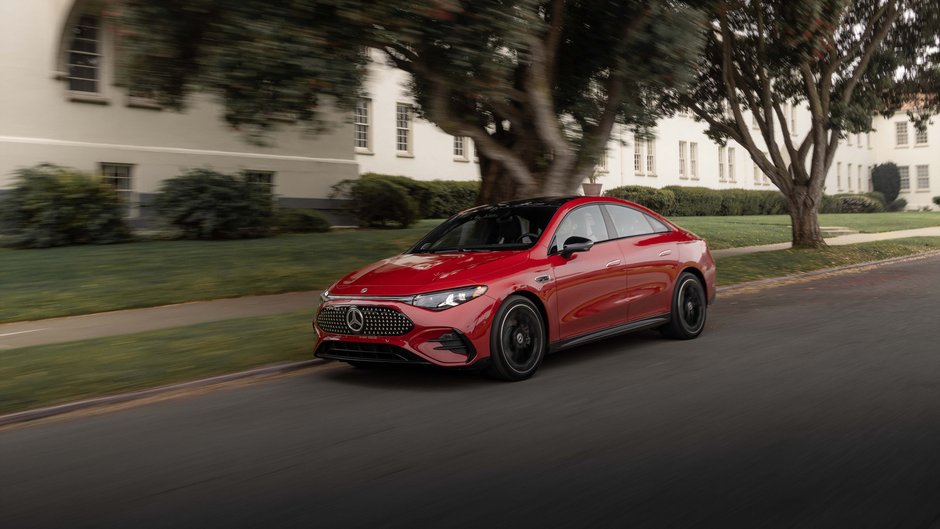
Lifting off the accelerator in the 2026 CLA feels different depending on how you’ve set it up. That’s not an accident. Mercedes-Benz built the all-electric CLA with a regenerative braking system the driver can dial in, rather than a single fixed behaviour every driver has to accept.
For Quebec shoppers cross-shopping their first EV, that adjustability matters more than a spec sheet number. It changes how the car feels in daily traffic, on the highway, and everywhere in between.
What Adjustable Regeneration Actually Is
Regenerative braking captures the kinetic energy created when the car slows down and sends it back to the battery, instead of letting it dissipate as heat through the brake pads. On the all-electric CLA, this happens through a new one-box brake system that combines the brake booster, master cylinder, and stability control into a single compact module.
What makes the CLA’s setup notable is choice. The driver picks how strongly the car slows when lifting off the accelerator, using a selector behind the steering wheel. There are four levels:
- D Auto, intelligent recuperation that adapts to the road ahead
- D+, no recuperation, for coasting
- D, standard recuperation, up to 1 m/s² of deceleration
- D-, enhanced recuperation, up to 3 m/s² of deceleration
How It Works Behind The Pedal
Pulling the steering-column lever toward the wheel increases recuperation strength; pushing it toward the driver display reduces it. A further press toggles between D+ and D Auto. Whatever level is active shows at the bottom of the driver display, so there’s no guessing.
Because the brake system is by-wire, pedal feel stays consistent whether the car is slowing through regeneration or through the conventional wheel brakes. Mercedes-Benz engineered the transition between the two to be unnoticeable from the driver’s seat. If the system detects a fault, it switches to hydraulic operation automatically, so braking stability is never compromised.
At the enhanced D- setting, the CLA can decelerate hard enough to bring itself to a full stop without the driver touching the brake pedal, recovering energy the entire way down. Recuperation power can reach up to 200 kW, and the system can even recover energy during ABS braking on slippery surfaces, a detail that matters on Quebec’s icy shoulder seasons.
In D Auto, the ECO Assistant adds another layer. It reads the navigation map, sensors, and cameras to anticipate curves, intersections, and traffic ahead, then prompts the driver with a lift-off cue on the display before easing into coasting or intelligent recuperation on its own.
Why It Matters In Everyday Driving

Stop-and-go commuting is where adjustable regeneration earns its keep. Repeated slowing and accelerating wastes energy in a conventional brake system; recovering that energy instead means fewer kilometres lost to traffic. A driver working through dense corridors can lean on D- for near one-pedal control, easing off the accelerator and letting the car do most of the slowing.
Highway driving asks for something different. Lighter regeneration, D or D+, lets the car coast more freely at speed, which feels more relaxed over long stretches and suits drivers who prefer traditional brake-pedal habits. Downhill sections on mixed suburban and rural routes are another case where stronger recuperation helps, since the car recovers energy on the descent instead of relying purely on friction brakes.
This isn’t a separate gimmick bolted onto the CLA. It’s part of the same efficiency-focused engineering that gives the CLA 250+ its 792 km WLTP range and the CLA 350 4MATIC its 771 km, both on an 85 kWh battery. Every kilometre recovered through regeneration is a kilometre the driver doesn’t have to find at a charging station.
Who Gets The Most Out Of This
Drivers doing frequent stop-and-go commuting, urban errands, or hilly routes will notice the biggest benefit from stronger recuperation settings, since these are exactly the driving patterns where lift-off braking happens most often. Someone splitting time between city traffic and longer highway runs can switch levels to match, rather than settling for a single compromise setting.
Shoppers comparing EV driving experiences beyond horsepower and range figures will also find this relevant. A car that lets the driver tune deceleration feel, while keeping brake-pedal response consistent through the transition to friction braking, offers a layer of control that a fixed single-mode system doesn’t.
Experience The CLA’s Regenerative Braking In Person
Adjustable regenerative braking gives CLA drivers a way to match deceleration feel to the road ahead, from stop-and-go commuting to open highway stretches, while helping preserve the electric range the CLA’s 85 kWh battery is built to deliver.
Visit Mercedes-Benz Laval in Laval to test the CLA’s recuperation levels for yourself and get your questions answered about the CLA 250+ and CLA 350 4MATIC.